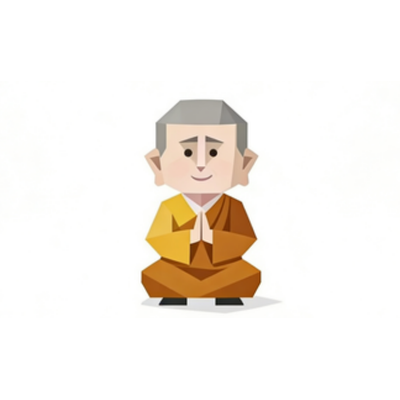
Free from worldly desires. Mostly.
MONK — The Monk: Complete SBTI Personality Guide
The Path to Enlightenment: Selected Koans for the Modern Ascetic
*The following teachings were transcribed from a series of conversations with a person who has not technically renounced worldly life but has, for all practical purposes, already left the building. They requested no attribution. They also requested to be left alone. We are honoring the second request after violating the first.*
Koan One: On Desire
A student asks the monk: "Don't you want anything?"
The monk replies: "This morning I wanted an iced coffee. So I sat with the wanting. I traced it backward — past the craving, past the caffeine dependency, past the restless night that caused the fatigue, past the doomscrolling that caused the restless night, all the way back to a single unresolved thought I'd been avoiding for three days."
"Once I saw the thought clearly, I didn't need the coffee anymore."
The student says: "That sounds like repression."
The monk says: "Repression is wanting something and forbidding yourself from having it. This is different. This is seeing through the wanting entirely — watching it dissolve the way fog dissolves when the sun hits it. You don't fight fog. You just wait, and look, and it goes."
The student buys an iced coffee anyway. The monk does not judge. The monk has already moved on.
Koan Two: On Solitude
A friend asks the monk: "Don't you get lonely?"
The monk considers the question for longer than the friend expected.
"Lonely assumes that being alone is a deficit," the monk finally says. "It assumes the natural state of a person is 'with others,' and that deviation from that state is a wound. But what if being alone is not an absence? What if it's a presence — the presence of yourself, undiluted?"
The friend says: "That's a nice philosophy but it sounds like cope."
"Maybe," says the monk. "But consider: when I'm alone, every thought is mine. Every silence is mine. Every hour is shaped by my own rhythm, not by the rhythm of a conversation I didn't choose. I am a perfectly still lake. I can see all the way to the bottom."
"When I'm with people, the lake gets stirred. The water is muddy. I can't see anything. That's not connection — that's turbulence."
The friend invites them to a party anyway. The monk declines. The monk was always going to decline. The friend knew this. The invitation was a formality. The decline was a tradition.
Koan Three: On Success
A relative asks the monk: "What are you doing with your life?"
The monk breathes.
"I mean professionally," the relative clarifies.
The monk continues breathing.
"You can't just *breathe* for a living."
The monk smiles — not dismissively, but with the particular gentleness of someone who has been asked this question many times and has given up explaining the answer.
Here is what the monk does not say, because it would take too long and the relative would not understand:
Success, as conventionally defined, requires you to want something you don't have, pursue it at great cost, obtain it, and then immediately begin wanting the next thing. It is a treadmill that disguises itself as a staircase. You feel like you're climbing, but you're standing in place, running, getting nowhere, forever.
The monk stepped off the treadmill. Not because they couldn't keep up — they kept up fine for years — but because one day they asked: "Where does this go?" And the answer, after much honest examination, was: "Nowhere. It goes to more treadmill."
So the monk stopped running. And in the stillness that followed, they discovered something that no promotion, no raise, no achievement had ever provided: the experience of not needing anything.
This is not laziness. This is the most expensive luxury in the modern world: contentment.
Koan Four: On Connection
A lover once asked the monk: "Can you let me in?"
The monk tried. Genuinely. They opened the door a crack and let warmth enter. It felt good. It felt dangerous. It felt like standing too close to a fire — pleasant at the periphery, threatening at the center.
The monk loved. Carefully, precisely, with boundaries drawn in clean geometric lines. "This much closeness, no more. This much vulnerability, no further." Love with a thermostat. Intimacy with a safety valve.
The lover wanted more. The lover always wants more. That's what lovers do — they push toward the center, toward the heat, toward the place where boundaries dissolve and two people become porous to each other.
The monk could not go there. Not because the love was insufficient, but because the monk understood something the lover didn't: to merge with another person, you have to lose the shape of yourself. And the monk had spent years — careful, quiet, deliberate years — learning that shape. Memorizing it. Protecting it.
The lover left. The monk sat with the leaving. It hurt, the way a splinter hurts — small, precise, manageable. Not the devastation the monk had feared. Just a sting that faded, leaving the shape intact.
The monk breathed. The shape held.
Koan Five: On Meaning
A stranger on the internet asks: "If you don't want anything and you don't do anything and you don't need anyone, what's the point?"
The monk types, deletes, types again, deletes again, and finally responds:
"Have you ever sat still for twenty minutes and just breathed?"
"No."
"Try it. Not as meditation. Not as a productivity hack. Not as a step toward anything. Just sit. Just breathe. Notice the air entering. Notice it leaving. Notice that this process — this automatic, unasked-for, miraculous exchange of oxygen and carbon dioxide — has been happening inside you every moment of your life without you ever once having to manage it."
"If that's not meaning, I don't know what is."
"But it's not *purpose*," the stranger objects.
"Correct," says the monk. "Meaning and purpose are not the same thing. Purpose is a direction. Meaning is a texture. A flower doesn't bloom *for* something. It just blooms. And the blooming is enough."
The stranger does not reply. The monk doesn't wait. The monk has already closed the app.
*End of transmission. The path continues, but the words stop here. The rest must be walked in silence.*
Dimension Breakdown
Self-Esteem & Self-Clarity (Both High): You know who you are with uncomfortable precision. Not in the confident, chest-out way — in the quiet, settled, "I've done the internal audit and filed the report" way. This self-knowledge is your anchor. It's also your fortress, and fortresses can become prisons if you're not careful.
Attachment Security (Low): Not because you can't trust — because you've decided trusting is optional. Your emotional alarm system is sensitive, but instead of managing it through connection, you've managed it through distance. Elegant solution. Potentially lonely one.
Emotional Investment (Low): You love carefully, if at all. When you do invest, it's precise and bounded — like a surgeon, not a flood. The people who receive your care get something rare and genuine. They just don't get a lot of it.
Social Initiative (Low): You are not going to reach out first. You are probably not going to reach out second. If someone wants to be in your life, they need to walk to your door and knock, and then wait, and then maybe knock again. The ones who persist discover something worth the effort. Most don't persist.
If You're a MONK
You've achieved something genuinely rare: peace. In a world of noise, you've built silence. In a world of wanting, you've found enough. That's not nothing — that's everything.
But here's the koan your practice hasn't solved yet: is your detachment wisdom, or is it armor? True equanimity is being at peace *in* the chaos, not *away* from it. If your calm only exists in controlled conditions — alone, quiet, undisturbed — it might be more fragile than it appears.
Test it. Not by forcing yourself into social situations you hate, but by occasionally allowing disruption. Let someone get close enough to be inconvenient. Say yes to one invitation you'd normally decline. See if the stillness holds when the water gets stirred. If it does, your practice is real. If it doesn't, that's not failure — that's information, and information is what monks are supposed to value most.
Dimension Analysis
You've got a solid read on who you are. A stranger's offhand comment isn't going to ruin your week.
You know your temper, your wants, and your hard limits. Self-awareness isn't your struggle.
Comfort and safety come first. Life doesn't need to be a nonstop grind — you'd rather not run a sprint you didn't sign up for.
Your relationship alarm system is hair-trigger sensitive. A 'seen' with no reply and you've already scripted the breakup scene in your head.
You're restrained with feelings — not heartless, just running enterprise-level security on who gets in.
Personal space is non-negotiable. No matter how deep the love, you need a room of your own.
You see the world through a defensive filter — suspect first, approach later.
Rules are suggestions you'd rather skip. Comfort and freedom usually outrank compliance.
Sometimes you have a goal, sometimes you just want to let it all rot. Your life philosophy is in standby mode.
Sometimes you want to win, sometimes you just want to not deal with it. Your motivation is a mixed bag.
You think it through but don't blue-screen. Normal, healthy hesitation.
Your productivity has a deeply committed relationship with deadlines. The closer the deadline, the more you ascend.
Your social engine is slow to start. Reaching out first takes about half a day of psyching yourself up.
Strong boundary game. Someone gets too close and your instinct is to take half a step back.
You read the room before you speak. A little honesty, a little diplomacy — you split the difference.
Compatibility

Related Types

Are you a MONK?
Take the SBTI personality test to find out your type.